

IBKR vs Alpaca vs Tradier for Technical Traders: API Stack Fit Checklist
Use this broker API checklist to decide whether IBKR, Alpaca, or Tradier fits your market access, execution control, data, and review workflow.
Note: this post was originally written on MyLinedChart. Get your 1st week free.
If you are a technical trader, the question is not which broker API has the best marketing page. The question is which stack supports the way you move from chart idea to order, review, and correction.
Key Takeaways
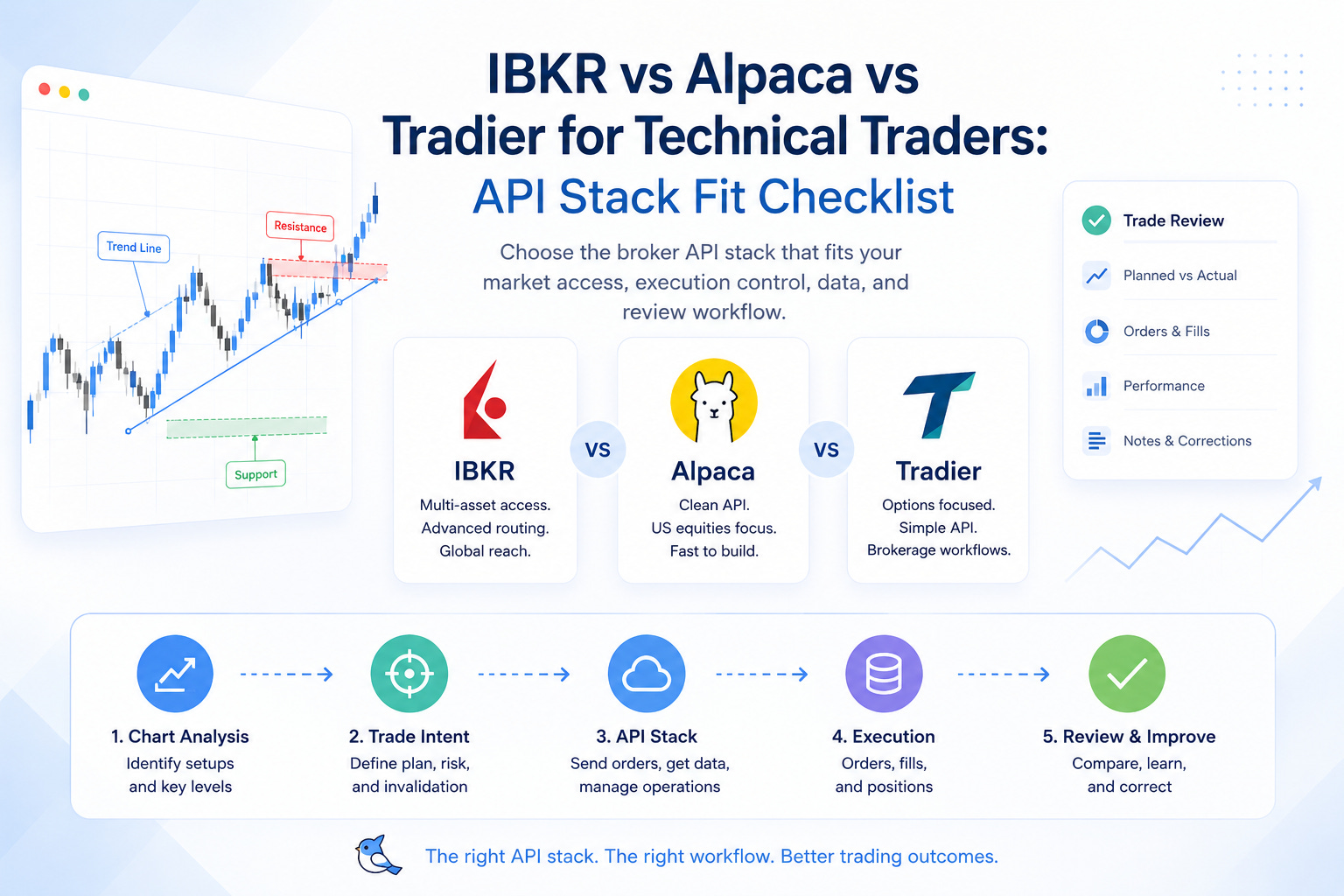
IBKR fits traders who need broad market access, mature order routing, and can handle setup complexity.
Alpaca fits builders who want a clean API for US equities, paper trading, and faster prototyping.
Tradier fits options-focused workflows that need a simpler API surface and fewer platform layers.
Quick Answer
Choose the API that matches your workflow, not the one that sounds most powerful in isolation. A technical trader needs market access, data reliability, order behavior, review evidence, and enough operational control to fix mistakes when the system behaves differently than expected.
If you trade multiple asset classes or need serious order routing, IBKR is usually the deeper stack. If you are building a clean US-equities prototype, Alpaca is often easier to start with. If your workflow is options-heavy and you want a simpler API surface, Tradier is worth evaluating.
Start with workflow fit before comparing feature lists.API StackBest FitMain TradeoffIBKRMulti-asset traders, advanced order routing, international accessMore setup friction and more operational detail to manageAlpacaUS-equities builders, paper trading, clean API prototypingNarrower market coverage than a full institutional-style broker stackTradierOptions-focused traders and simpler brokerage API workflowsLess broad as an all-purpose trading infrastructure layer
What You Are Really Choosing
A broker API is not just a pipe for orders. It becomes part of your operating process. It decides what data you can request, how orders are represented, how errors surface, how fills are reconciled, and how much work it takes to audit what happened after the session.
That matters because technical traders usually lose quality in the handoff between chart analysis and execution. The chart idea may be clear, but the order path, data model, and review trail can still create avoidable errors.
Can the API support the markets and instruments you actually trade?
Can you inspect rejected, partial, delayed, or modified orders without guessing?
Can your review process compare planned chart context against actual order behavior?
Can you start small without building a fragile system you will need to replace later?
Comparison Matrix
Use this matrix as a first-pass fit check. It is not a final vendor decision. It tells you where to spend your testing time before you commit a workflow to one stack.
The right stack depends on the trading process you need to operate, not only the API documentation.Fit AreaIBKRAlpacaTradierMarket accessBest fit when you need broad instruments and global reachBest fit for US equities-focused buildsBest fit when options workflows are centralBuild speedSlower initial setup, more moving partsFastest for clean prototypesGenerally simpler than a broad multi-asset stackOrder controlStrong for advanced routing and detailed execution workflowsGood for straightforward equity order workflowsGood for options-oriented brokerage workflowsOperational burdenHighest learning curveLowest initial frictionModerate, depending on options workflow complexityReview workflowStrong if you preserve order and context data carefullyGood if your schema is simple and consistentGood if you keep options context explicit
Choose IBKR If
IBKR makes sense when your workflow needs depth: multiple asset classes, broader market access, more advanced order handling, or a path toward a serious execution stack.
The tradeoff is complexity. You need to be comfortable with account permissions, data subscriptions, connection behavior, order states, and more detailed reconciliation. That extra work can be worth it if your strategy needs the reach and control.
You trade beyond simple US-equity prototypes.
You care about detailed execution controls and order-state visibility.
You are willing to document permissions, data feeds, and operational failure modes.
You want a stack that can grow beyond a narrow first build.
Choose Alpaca If
Alpaca makes sense when speed, clarity, and prototype momentum matter. If your first goal is to build, test, and learn around a US-equities workflow, a cleaner API surface can reduce friction.
The risk is choosing ease before you know your long-term requirements. If your future workflow needs broader instruments, more broker-side controls, or a different data model, validate that early.
You want a clean API to start building quickly.
Your first workflow is US-equities focused.
Paper trading and developer experience matter more than broad broker coverage.
You are still proving the process before scaling infrastructure complexity.
Choose Tradier If
Tradier is worth a close look when options are central to the workflow and you want a brokerage API that does not feel like a full multi-asset infrastructure project.
The key test is whether the API gives you enough structure to preserve options context, order intent, and review data. If your process depends on spreads, expirations, deltas, or position adjustments, your schema has to capture those details cleanly.
Options workflows matter more than broad multi-asset coverage.
You want a simpler brokerage API surface than a heavyweight stack.
Your review process can preserve option-specific context.
You are evaluating stack fit around real order and position workflows.
Stack-Fit Checklist
Before you choose, test one real workflow end to end. Do not compare APIs only by reading documentation. Compare what happens when a chart setup becomes a planned order, the order is routed, the result is logged, and the trade is reviewed.
Pick one setup family and one instrument type.
Write the fields your system must preserve before, during, and after the trade.
Run the same paper or micro-size workflow through each candidate stack.
Log rejects, partial fills, latency, data gaps, and manual overrides.
Choose the stack that leaves the clearest review trail, not just the fastest demo.
Where MyLinedChart Fits
MyLinedChart sits before and after the broker API. Before the order, it helps preserve the chart context: levels, drawings, notes, symbols, timeframes, and the setup reason. After the order, that context gives your review process something concrete to compare against actual execution.
That is the missing layer in many API projects. The broker can tell you what order was sent. It usually cannot explain the chart decision the trader thought they were acting on unless you preserve that context yourself.
Next Step
If you are choosing between IBKR, Alpaca, and Tradier, start by writing your workflow requirements in plain language. Then test one narrow path from chart setup to order review.
Use IBKR Automation & Integration if you want the broader IBKR workflow map, and use the sample exports below to see how structured chart context can support a broker API build.
FAQ
Which broker API is best for technical traders?
There is no universal best choice. IBKR is usually stronger for broad market access and advanced routing, Alpaca is often easier for US-equities prototypes, and Tradier is worth evaluating for options-focused workflows.
Should I choose the easiest API first?
Only if the easy API supports the workflow you need to run. Fast setup is useful, but not if you later discover that market access, order controls, or review data are missing.
What should I test before committing to a broker API?
Test one complete path: chart setup, planned order, routed order, order result, error handling, and post-trade review. The best stack is the one that leaves the least ambiguity.
This post was originally written on MyLinedChart. Get your 1st week free.
Enjoying this content?
Subscribe on Substack