

No One Can Teach You to Trade. Art School Can't Make You Picasso Either.
Trading education can give you tools, but your edge has to become yours through structure, repetition, review, and execution evidence.
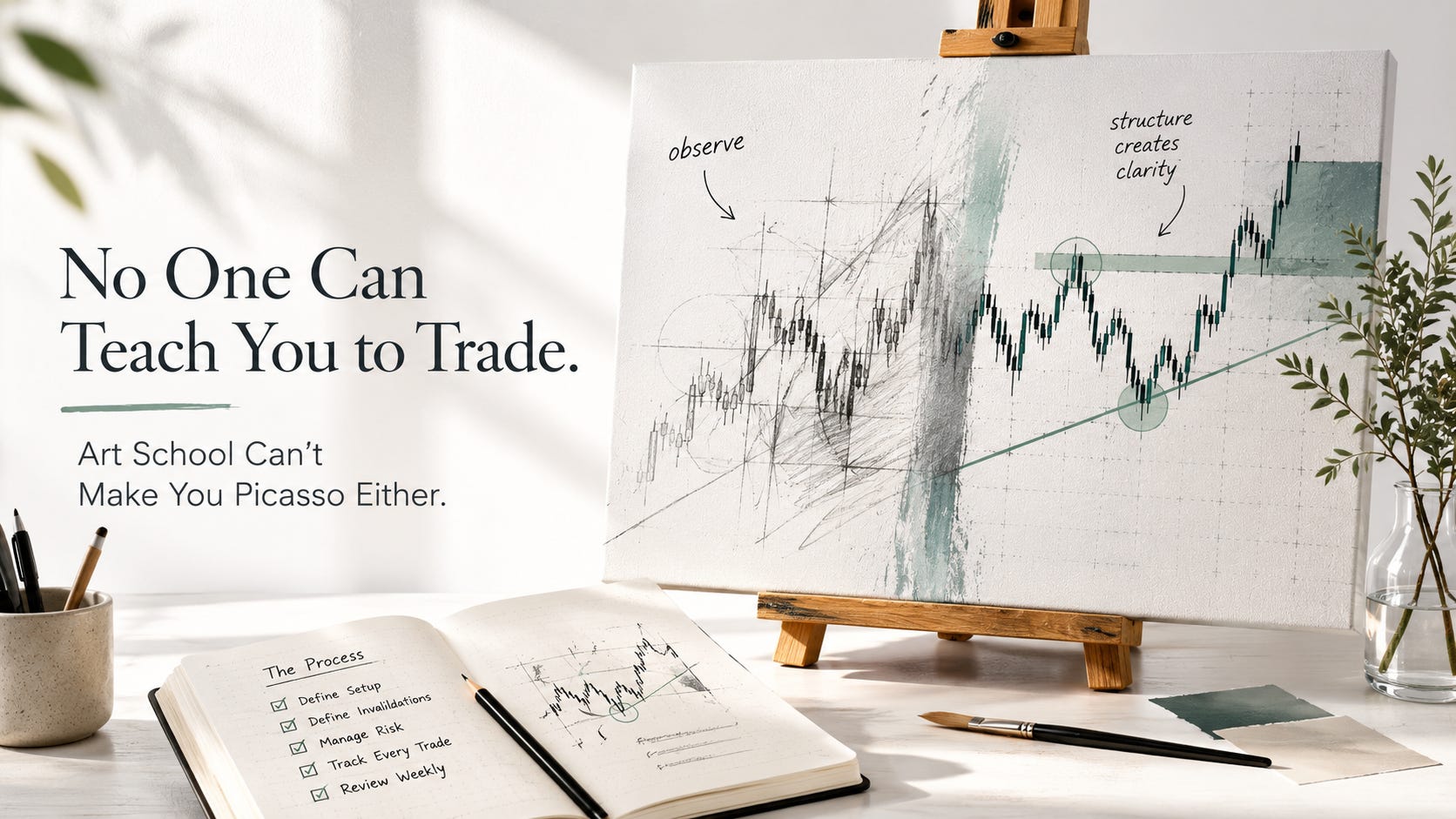
Originally published on MyLinedChart: No One Can Teach You to Trade. Art School Can’t Make You Picasso Either.
Get your first week of MyLinedChart for free.
No one can teach you to trade in the way most new traders secretly want to be taught.
They can teach you tools.
They can teach you vocabulary.
They can show you trendlines, support and resistance, VWAP, order flow, risk models, journals, checklists, and review routines.
They can show you how they see the market.
But they cannot give you your eye.
That is the part most traders avoid because it removes the fantasy of transfer. If someone else could hand you their edge, trading would be simple. You would find the right teacher, copy the right setup, follow the right alert, and wait for consistency to arrive.
But trading does not work that way.
Art school can teach composition, color, proportion, negative space, and critique. It can expose you to masters. It can give you assignments. It can force repetition.
It cannot make you Picasso.
The same is true in trading.
A trading educator can help you understand structure. A coach can help you see mistakes faster. A platform can help you organize context. A community can expose you to patterns you would not have noticed alone.
But the edge still has to become yours.
That means your chart eye has to form through repetition. Your rules have to survive your own pressure. Your review process has to catch your own drift. Your trading identity has to be built through evidence, not borrowed confidence.
Most traders do not fail because no one taught them anything.
They fail because they never convert what they were taught into a process they can actually run.
They collect strategies but do not test them deeply.
They watch charts but do not review decisions.
They journal outcomes but do not diagnose behavior.
They admire someone else’s style before building their own structure.
That is backwards.
Style comes after process.
Picasso could break form because he understood form. A trader can develop personal discretion only after proving they can follow clear constraints. Until then, “style” is often just inconsistency with better branding.
The better question is not, “Who can teach me to trade?”
The better question is, “What process will reveal how I trade under pressure?”
That is where the work begins.
Pick one setup.
Define the conditions that make it valid.
Define the conditions that invalidate it.
Track every time you follow the rule.
Track every time you break the rule.
Review the evidence weekly.
Upgrade one rule at a time.
Do not change everything after one bad day. Do not declare mastery after one good week. Do not confuse emotional relief with process improvement.
Your edge starts with you, but that does not mean it lives in your head.
It has to become visible.
It has to be written.
It has to be reviewed.
It has to survive the days when you are tired, impatient, overconfident, frustrated, or tempted to force one more trade.
That is why structured chart context matters. If your drawings, notes, setup logic, and execution decisions disappear into screenshots and memory, your process cannot compound cleanly.
You need a way to see what you actually did.
Not what you remember doing.
Not what you meant to do.
Not what you would have done if you were calmer.
What you actually did.
That is the beginning of self-coaching.
The goal is not to become someone else.
The goal is to become the trader only you can become, with enough structure that your personal judgment is trained instead of improvised.
No one can teach you to trade.
But the right process can teach you how you trade.
And once you can see that clearly, you can start building an edge that belongs to you.
Enjoying this content?
Subscribe on Substack