

Your Edge Starts With You: 5 Process Breakdowns I See Repeated Across TradingView, TrendSpider, and Trading Journals in 2026
Most traders do not fail because they cannot read charts. They fail because they cannot repeatedly execute what they already know under pressure.
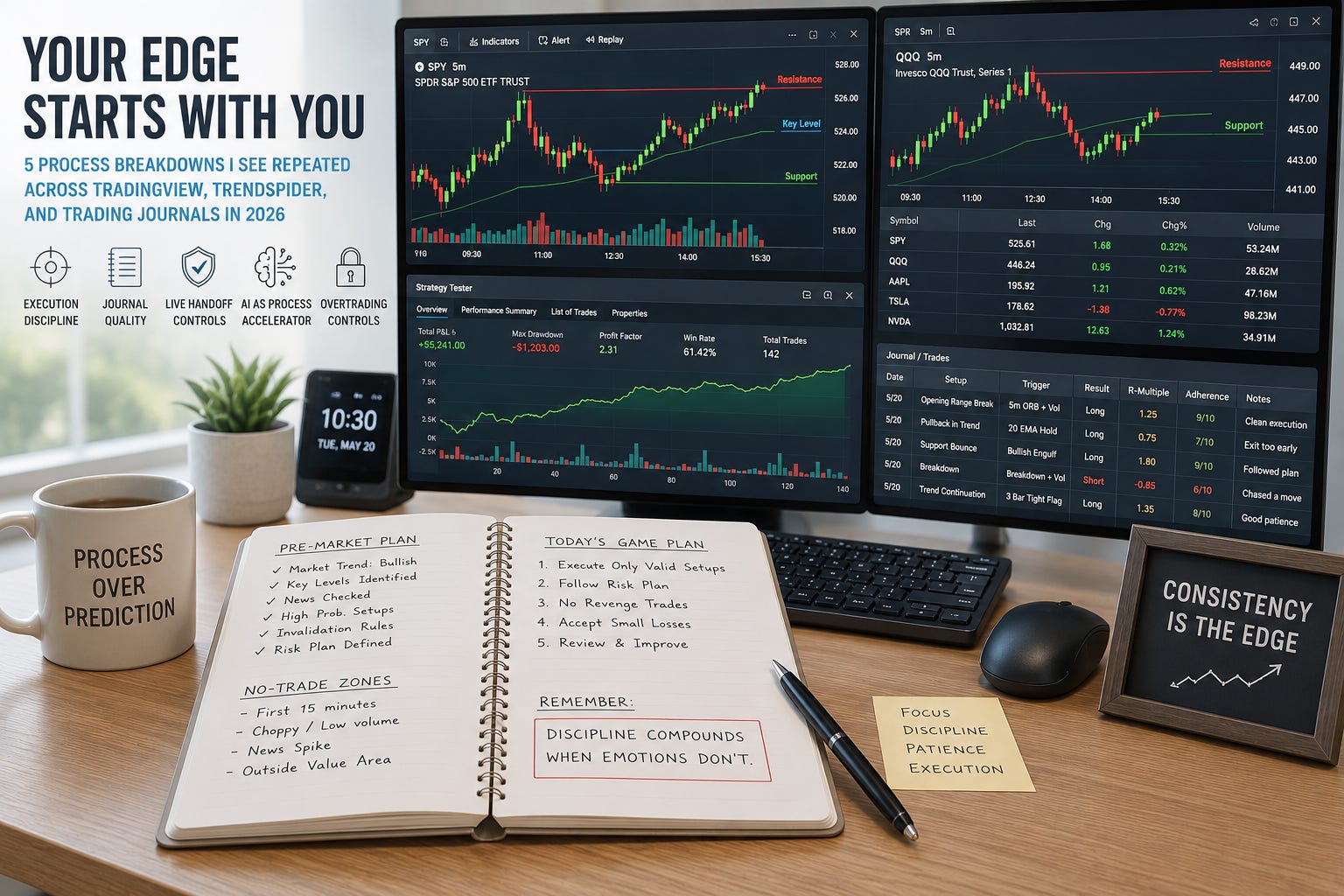
Originally published on MyLinedChart: Your Edge Starts With You: 5 Process Breakdowns I See Repeated Across TradingView, TrendSpider, and Trading Journals in 2026
Get your first week of MyLinedChart for free.
Breakdown 1: Insight-Rich, Execution-Poor Workflows
You can have strong chart reads and still underperform when trigger grammar and invalidation logic are inconsistent.
The usual pattern is good pre-market analysis followed by mid-session discretionary drift that cannot be audited cleanly.
For an operator loop that closes this gap, see Your Edge Starts With You: How Traders Turn Good Reads Into Repeatable Results.
Define trigger grammar before open.
Freeze one invalidation rule per setup.
Review planned-versus-executed behavior daily.
Breakdown 2: Journal Fields That Cannot Diagnose Behavior
Outcome-only logs can track performance history, but they cannot diagnose why process quality drifted.
A useful journal captures setup class, trigger condition, invalidation logic, adherence score, and one corrective action.
If you need a field framework, use The 2026 Day Trading Journal Framework: 7 Fields That Expose Execution Drift.
Log decision context at entry, not only outcomes at exit.
Keep taxonomy fixed long enough to compare weeks.
Upgrade one rule per week from repeated evidence.
Breakdown 3: Backtest Confidence Without Live Handoff Controls
Model quality and execution quality are not the same variable. Backtest confidence often collapses live because incident classes are untracked.
Without separate tags for model drift, execution drift, and risk-rule breaches, correction cycles stay vague.
For handoff controls, see TrendSpider Strategy Bot Reality Check: Why Backtests Break Live and How to De-Risk the Handoff.
Classify incidents by root category.
Pilot one market and one bot before scaling.
Scale only after adherence stability improves.
Breakdown 4: AI Used as Signal Oracle Instead of Process Accelerator
Claude Code and ChatGPT Codex can improve trading workflows, but they fail when used to bypass risk discipline.
AI amplifies structure. If your process data is weak, it amplifies weak decisions faster.
For a practical AI operating model, see AI Trading in 2026: Use Claude Code and ChatGPT Codex to Improve Process, Not Predict Price.
Use AI for checklist drafting and exception clustering.
Keep trader judgment as final authority.
Measure AI value by adherence and drift reduction.
Breakdown 5: No Hard Controls for Overtrading Episodes
Overtrading is usually a systems bug, not a motivation issue. Without hard controls, one loss-event can cascade into avoidable damage.
Daily loss locks, trade caps, and cooldown rules protect execution quality for the next session.
For control-stack implementation, use Stop Overtrading by Design: Daily Loss Locks, Trade Caps, and Session Shutdown Rules.
Set hard daily loss locks.
Enforce trade caps and cooldown timers.
Run a non-optional shutdown protocol after breach.
Practical Weekly Cadence
Monday: define active setup grammar and no-trade states. Tuesday through Thursday: execute only qualified setups and tag deviations in real time.
Friday: run adherence-first review and deploy one rule upgrade. Weekend: operationalize the next-week checklist.
For measurable governance, pair this with Edge Scorecard: 12 Metrics to Prove Your Trading System Is Actually Improving.
Actionable Starter Sprint (7 Days)
Pick one setup family and define one trigger grammar.
Set one invalidation rule and one hard stop condition.
Journal each trade with setup class, adherence score, and one corrective action.
Tag every deviation as model drift, execution drift, or risk-rule breach.
Run Friday adherence review and deploy one concrete rule upgrade.
Closing: Systems First, Narrative Second
The highest-leverage upgrade for most traders is process reliability, not indicator count. Your edge starts with you, and it compounds when your loop is stronger than your excuses.
To operationalize this with structured chart context, see MyLinedChart product page.
FAQ
Is this only for advanced traders?
No. The framework works for developing and advanced traders because it focuses on repeatable process controls.
What should I fix first?
Start with one breakdown category where you see repeated losses and i
nstall one control you can enforce immediately.
How quickly should I expect results?
Behavior quality usually improves before P&L. Watch adherence and drift metrics first.
Originally published on MyLinedChart: Your Edge Starts With You: 5 Process Breakdowns I See Repeated Across TradingView, TrendSpider, and Trading Journals in 2026
Enjoying this content?
Subscribe on Substack