

Your Edge Starts With You: The One-Rule Week That Turns Chart Insight Into Repeatable Execution
Build compounding execution quality in seven-day cycles by upgrading one behavior rule at a time instead of rebuilding your full system every week.
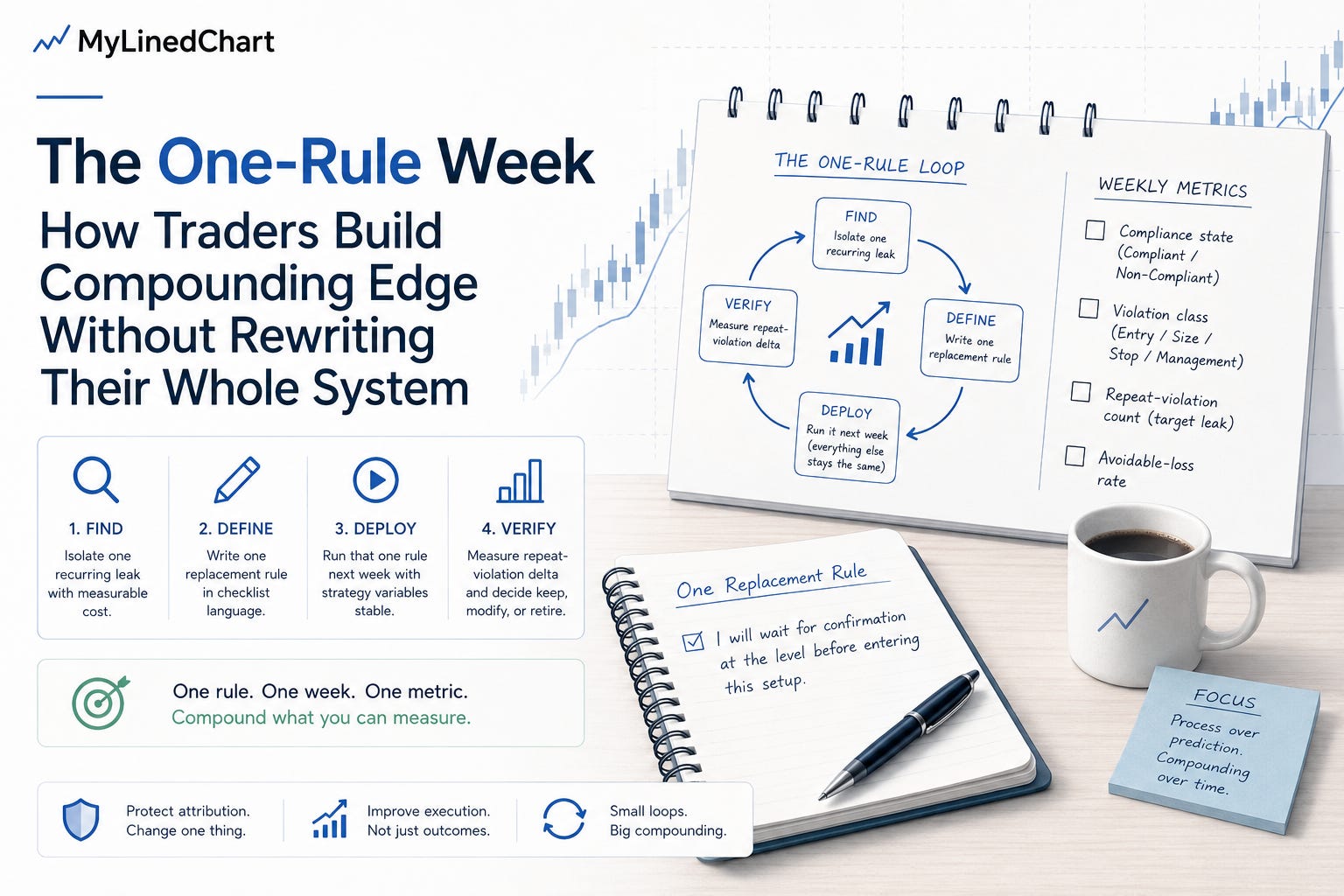
Originally published on MyLinedChart: The One-Rule Week: How Traders Build Compounding Edge Without Rewriting Their Whole System
Get your first week of MyLinedChart for free.
https://mylinedchart.com/
Most traders who feel stuck are not short on ideas. They are short on a loop that preserves comparability. You can read strong market context on Monday and still end Friday with zero measurable process gain if your week has too many moving parts. Your edge starts with you, but compounding starts when your weekly process changes are narrow enough to test and strong enough to survive pressure.
The one-rule week is a practical operating model. You identify one recurring leak, deploy one replacement control, and measure one leading metric before changing anything else. This sounds simple because it is simple. The hard part is keeping it simple when markets get noisy and confidence gets emotional.
Why Insight Alone Does Not Compound
Most traders evaluate themselves with a direction-first scorecard: was I right about price? That is incomplete. A right forecast with poor execution behavior can still degrade your process quality. A wrong forecast with strong compliance can still improve your long-term expectancy mechanics.
That is the core contrast you need to hold: insight vs execution. Insight tells you where opportunity might exist. Execution determines whether opportunity becomes repeatable outcome. If you only track outcomes, you hide the mechanism that created them.
If you want the full process architecture, start with Your Edge Starts With You: How Traders Turn Good Reads Into Repeatable Results and Your Edge Starts With You, but the Data Layer Decides Whether It Actually Compounds.
The One-Rule Week Operating Loop
The loop has four steps: find, define, deploy, verify.
Find: isolate one recurring leak with measurable cost. Use repeat frequency and loss impact, not frustration level.
Define: write one replacement rule in checklist language. A good rule is operational under stress, not poetic in review notes.
Deploy: run that one rule next week with strategy variables stable.
Verify: measure repeat-violation delta and decide keep, modify, or retire.
This is where most loops break. Traders deploy multiple changes, then lose attribution. If three rules change and behavior improves, you cannot tell which change caused the gain. That kills compounding because you cannot reliably repeat what worked.
What to Track During the Week
You do not need a large dashboard to run this loop. You need a stable one. Start with:
Compliance state per decision (compliant or non-compliant).
Violation class (entry timing, size drift, stop drift, or management drift).
Repeat-violation count for your targeted leak.
Avoidable-loss rate for non-compliant trades.
Keep this taxonomy fixed for the cycle. Changing labels midweek creates fake progress. If you want an export workflow that supports this structure, review Export Chart Data With Notes for Real Trade Journals and Chart Annotation Export for Trading Journal XLSX/CSV.
Seven-Day Sprint You Can Run Immediately
Pick one setup family and one instrument.
Label each decision compliant or non-compliant in real time.
Friday: choose the highest-frequency leak.
Write one replacement control statement.
Deploy next Monday with all other strategy rules unchanged.
Friday next week: measure repeat-violation change.
This loop is small by design. Small loops are not weak loops. Small loops are attributable loops.
Using AI in the Loop Without Losing Governance
AI can help, but only in the right role. Use AI to cluster drift patterns and suggest control language. Do not use AI as an in-session override engine. The operator must keep authority over risk boundaries and final execution rules.
For implementation, use Claude Code and ChatGPT Codex for Traders: A Weekly Edge-Upgrade Workflow plus Claude Code + ChatGPT Codex for Traders: How to Turn Weekly Reviews Into One Measurable Rule Upgrade.
Prompt stability matters as much as rule stability. If you change prompt structure every week, recommendation quality cannot be compared honestly.
How This Prevents Signal Chasing
Signal-rich environments create urgency and urgency creates reaction errors. The one-rule loop protects you by keeping improvement anchored to behavior quality instead of alert volume. You can pair it with a triage protocol like AI Trading Signals Under Pressure: A Triage Protocol for Noise, Conflicts, and Late Entries so alerts flow through process filters instead of bypassing them.
Related Read Sequence
If you want to run this as a structured progression, read in this order:
Closing Thesis
Your edge starts with you, but your loop determines whether that edge compounds or leaks. The one-rule week is not a motivational slogan. It is a governance mechanism that preserves attribution, increases comparability, and improves execution quality with less noise.
If you want a workflow layer that keeps chart context, structured exports, and weekly upgrade cycles connected, explore MyLinedChart.
Originally published on MyLinedChart: The One-Rule Week: How Traders Build Compounding Edge Without Rewriting Their Whole System
Get your first week of MyLinedChart for free.
https://mylinedchart.com/
Enjoying this content?
Subscribe on Substack